Numerical Analysis of
Static Airfoil Stall
Validating the VPMFoam solver against established low-Reynolds benchmarks to prove high-fidelity wake preservation in separated flows.
Project Context
The Problem
Airfoil stall is the catastrophic loss of lift caused by flow separation. In traditional CFD, numerical diffusion often "smears" the wake, leading to inaccurate drag and lift predictions near the critical angle of attack.
The Objective
This study validates the VPMFoam hybrid solver at $Re=1000$. By using a Lagrangian approach for wake convection, we ensure the solver is reliable for complex industrial applications like wind turbine blade optimization.
Computational Setup
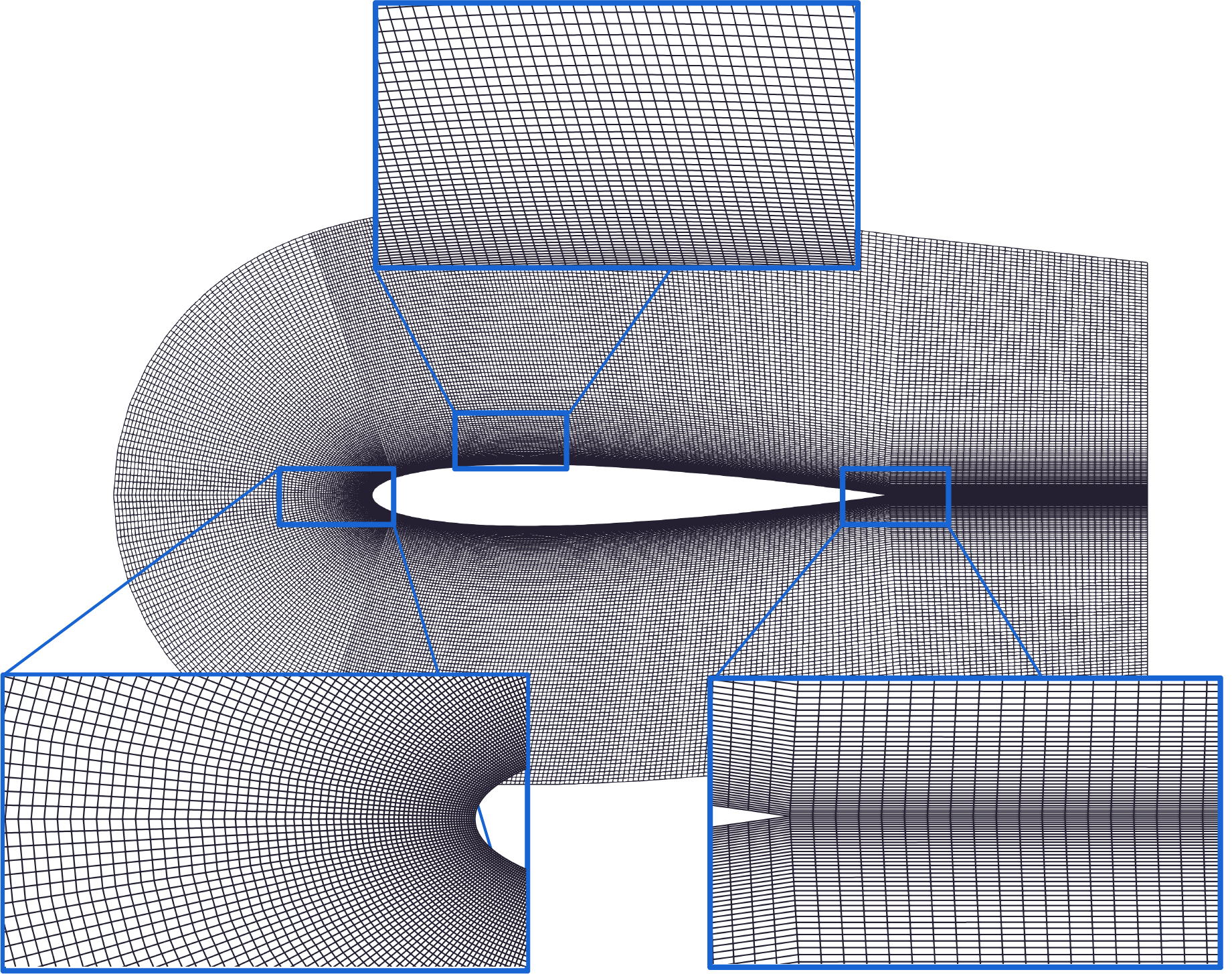
We employed a C-shaped hexahedral mesh constructed in Gmsh. The Eulerian mesh is intentionally narrow, resolving only the viscous boundary layer. The rest of the domain is resolved by Vortex Particles, reducing mesh dependency and computational cost.
- >> $Re$: 1000
- >> $\Delta t$: $5 \times 10^{-4}$ s
- >> Solver: VPMFoam (Hybrid)
Validation Results
Lift Comparison
Drag Comparison
Aerodynamic Efficiency
Analysis across angles ranging from 0° to 30° confirms that VPMFoam accurately predicts the stall angle at 15°. This correlates nearly perfectly with literature benchmarks [1,2], demonstrating the solver's ability to maintain wake fidelity where traditional Eulerian methods fail.
Literature Benchmarks
[1] Pasolari, R., Ferreira, C. S., & van Zuijlen, A. (2024). Phys. Fluids.
[2] Koumoutsakos, P., & Leonard, A. (1995). J. Fluid Mech.